
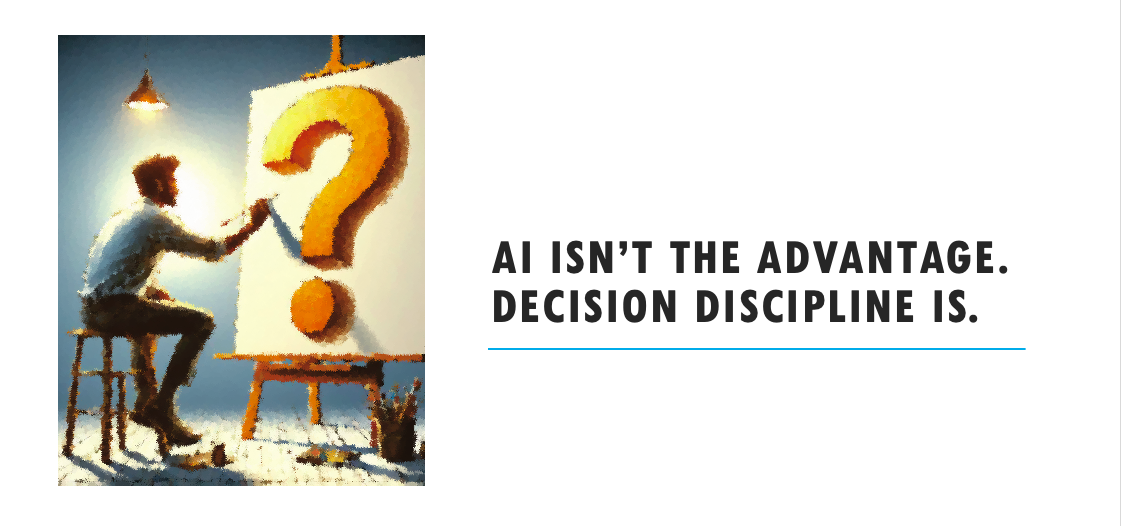
Just yesterday, a leader working deeply in the AI space asked me a simple but powerful question on LinkedIn:
“What’s one fresh trend you think is going to impact the market?”
It made me pause.
Not because there aren’t trends everywhere, there are too many.
But because most conversations around AI are still happening at the wrong altitude.
We are obsessed with tools. The real shift is happening in decision-making.
From AI as a Tool to AI as a Decision Layer
For the last few years, AI has been positioned as an accelerator:
- Faster automation
- Smarter analytics
- Better predictions
Useful? Yes.
Transformational? Not by default.
The next real wave is not AI doing more work. It’s AI becoming an embedded decision layer inside businesses.
That means AI doesn’t just execute tasks, it informs, influences, and sometimes challenges:
- What gets prioritised
- What gets funded
- What gets stopped
- What gets scaled
And that is where most organisations are unprepared.
Why Faster Automation Won’t Create Winners
There’s a popular belief that companies that adopt AI faster will win.
I disagree.
Speed without structure only magnifies chaos.
I’ve worked with enough growth-stage and mature businesses to see this pattern clearly:
- AI dashboards everywhere, but no ownership
- Automated reports, but no decisions taken
- Predictive insights, but no accountability for acting on them
The result? More data. Same indecision.
The winners won’t be those who automate faster.
They will be the ones who redesign how decisions are made.
The Real Redesign Leaders Must Do
Embedding AI as a decision layer requires leaders to confront uncomfortable questions:
- Who owns a decision when AI informs it?
- What decisions stay human and why?
- How do we audit judgment, not just output?
- What happens when AI contradicts hierarchy or instinct?
This is not a technology challenge.
This is a leadership and operating-model challenge.
AI exposes weak governance faster than it creates efficiency.
Execution Discipline Is the Differentiator
Here’s the hard truth most leaders avoid:
AI will not fix poor execution culture. In fact, it punishes it.
When AI is embedded into decision flows:
- Delayed decisions become visible
- Avoided trade-offs become obvious
- Lack of clarity shows up instantly
Which is why execution discipline will matter more than tech adoption itself.
Companies that win will have:
- Clear decision rights
- Defined escalation paths
- Measurable accountability
- Leaders comfortable being challenged by data
AI doesn’t replace judgment. It demands better judgment.
What This Means for Leaders Right Now
If you’re a founder, CXO, or business leader, the question is no longer:
“How do we use AI?”
The better question is:
“Which decisions define our outcomes and how should AI support them?”
Start there.
Not with tools. Not with pilots. With decisions.
Because in the coming years, competitive advantage won’t belong to the most automated company but to the one with the clearest thinking, strongest execution discipline, and most courageous leadership.
And that shift has already begun.
Leave a Reply