
Everyone talks about vision. Very few talk about execution.
In my three decades of working with founders, leadership teams, and high-potential companies, I’ve seen one pattern repeat itself relentlessly:
Execution isn’t talent. It isn’t motivation & it definitely isn’t hustle.
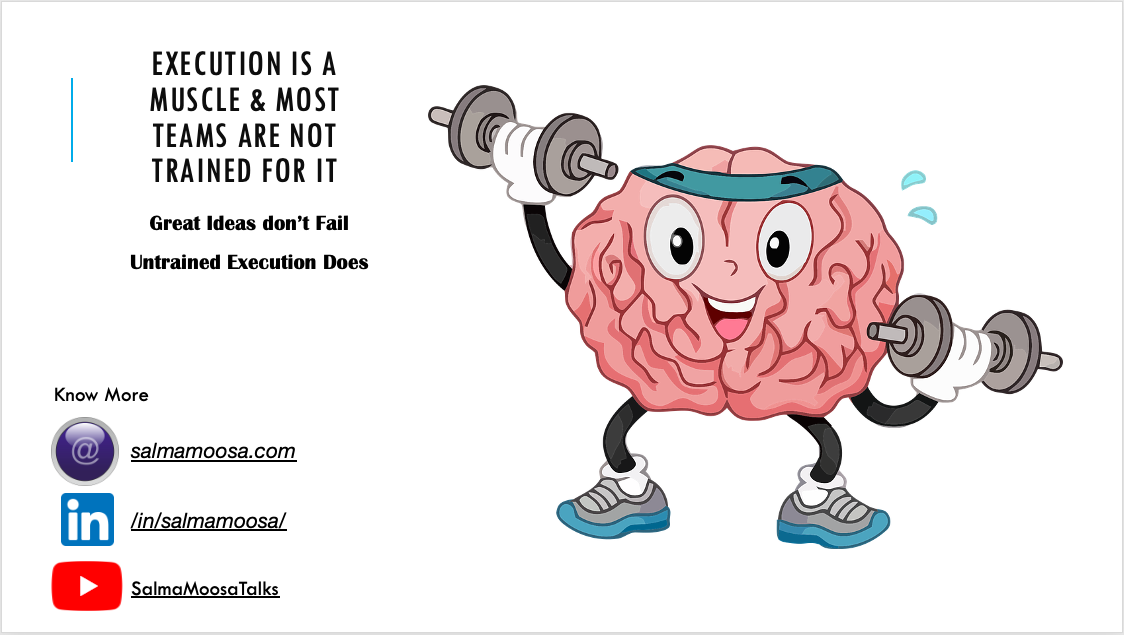
Execution is a muscle.
And like any muscle, if you don’t train it consistently, it weakens, no matter how smart, funded, or ambitious the team is.
The Execution Myth: “We’ll Figure It Out Along the Way”
Most teams assume execution will magically happen once the strategy is clear.
It doesn’t.
What usually happens instead:
• Priorities keep shifting
• Decisions get delayed “until we have more data”
• Teams stay busy but outcomes stay flat
• Accountability becomes blurred
• Founders step in to “fix things”, again
The problem isn’t effort. The problem is lack of execution conditioning.
You don’t build muscle by reading about fitness. You build it by showing up, lifting consistently, resting intentionally, and correcting form. Execution works the same way.
What Untrained Execution Looks Like
Most teams don’t realise their execution muscle is weak because it doesn’t look like failure. It looks like activity.
Here are the symptoms:
• Too many initiatives, too few closures
• Long meetings, short action lists
• Goals without owners
• Owners without authority
• Feedback without follow-through
• Reviews without course correction
On the surface, things look “fine.” Underneath, momentum is leaking quietly.
This is where companies stall, not dramatically, but slowly.
Why Smart Teams Struggle the Most?
Ironically, intelligent, high-potential teams struggle with execution more than others.
Why?
Because thinking becomes a substitute for doing.
• More analysis replaces decisions
• More planning replaces movement
• More discussion replaces ownership
Execution doesn’t reward intelligence alone. It rewards clarity, discipline, and repetition.
Teams that over-intellectualise execution often confuse motion with progress and wonder why growth feels heavier every quarter.
Training the Execution Muscle: What Actually Works
Execution strength doesn’t come from pressure. It comes from structure and rhythm.
Here’s what I’ve seen work repeatedly across companies, sectors & including for myself for these years:
1. Fewer Priorities, Ruthlessly Chosen
Strong execution starts with subtraction. If everything is important, nothing moves.
Teams with trained execution muscles know:
• What matters this quarter
• What gets paused
• What gets killed without guilt
2. Clear Ownership (Not Group Responsibility)
Execution dies in shared ownership.
Every outcome must have:
• One owner
• Clear authority
• Measurable definition of “done”
Clarity removes friction. Friction kills momentum.
3. Short Feedback Loops
Execution thrives on fast correction, not perfection.
Weekly or bi-weekly checkpoints matter more than monthly reviews.
Not to blame but to recalibrate. Muscle grows through feedback. So does execution.
4. Decisions Have Expiry Dates
Untrained teams keep decisions open forever. Trained teams decide, test, learn, and move. Even a wrong decision executed well teaches more than a perfect decision delayed endlessly.
5. Founders Step Back, Intentionally
When founders constantly jump in to rescue execution, teams never build the muscle themselves. Strong leaders don’t disappear. They create conditions where execution can stand without them. That’s not disengagement. That’s maturity.
Execution Is Emotional, not Just Operational
Here’s the part most people miss:
Execution isn’t just about systems. It’s about emotional readiness.
• Fear of getting it wrong
• Fear of accountability
• Fear of conflict
• Fear of being visible
These fears show up as delays, over-planning, or silence. Teams that execute will feel safe to act, fail fast, and learn. Psychological safety isn’t a “soft” concept, it’s an execution accelerator.
The Quiet Truth About Sustainable Growth
Sustainable growth doesn’t come from big breakthroughs every quarter.
It comes from:
• Doing small things consistently
• Closing loops
• Holding standards
• Showing up even when motivation dips
That’s muscle memory, and like physical fitness, execution doesn’t need drama.
It needs discipline.
A Final Thought
Vision inspires. Strategy directs. But Execution Decides.
If your team feels tired, stuck, or “busy but not moving,” don’t look for a new plan.
Look at the muscle. Train it. Respect it. Build it slowly.
Because companies don’t fail from lack of ideas, they stall from lack of execution strength.


Leave a Reply to salmamoosa Cancel reply