
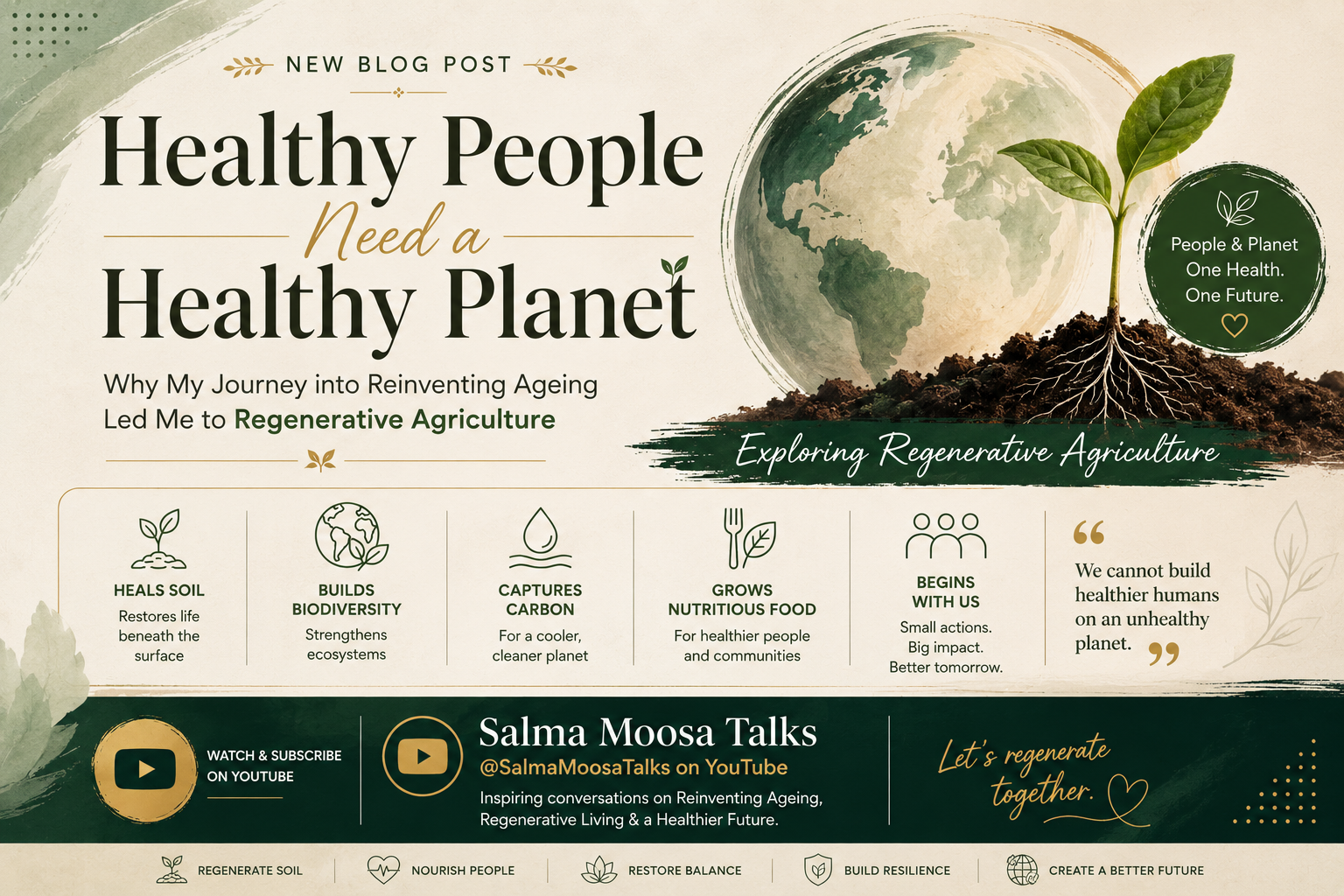
Why My Journey into Reinventing Ageing Led Me to Regenerative Agriculture
There comes a point in every journey when one realization changes everything.
Mine began with health.
After years of struggling with my body, my weight, my emotions and eventually finding my way back to wellness, I believed I had found the answer. Eat better. Walk more. Sleep well. Breathe deeply. Repeat.
But somewhere along this journey, another question quietly entered my mind.
How can we expect healthy people if the planet itself is unhealthy?
That one thought refused to leave me.
Suddenly I found myself reading about soil instead of supplements, farms instead of fitness plans, microbes instead of medicines and food systems instead of calorie counts.
I also realized something else.
We have spoken so much about sustainability that the word has almost become background noise. It appears in every conference, every corporate report and every social media campaign, yet our rivers continue to suffer, our soils continue to weaken and our food continues to lose its natural richness.
That was when I discovered Regenerative Agriculture.
Unlike sustainable agriculture, which focuses on reducing damage, regenerative agriculture asks a far more powerful question:
How do we heal what has already been damaged?
It is an approach that works with nature instead of against it.
Instead of exhausting the soil with chemicals, it feeds it with organic matter. Instead of leaving land exposed, it keeps it covered with living plants. Instead of monoculture, it encourages diversity. Instead of seeing farms as factories, it sees them as living ecosystems where soil, insects, birds, water, animals and humans are all interconnected.
Healthy soil captures more carbon, stores more water, grows more nutritious food and supports stronger biodiversity. In many ways, regenerative agriculture is not just farming.
It is regeneration itself.
The beautiful part is that this movement does not belong only to large farmers or governments. It can begin in our own balconies. It can begin with composting kitchen waste instead of throwing it away. It can begin by growing herbs in recycled containers. It can begin by supporting local farmers who grow naturally. It can begin by planting one native tree, creating one pollinator-friendly garden or simply choosing food that nourishes both our bodies and the earth that produced it. Small actions multiplied across millions of people become movements and movements change civilisations.
Connecting the Dots
The more I read about regenerative agriculture, the more I realized that it wasn’t just a farming practice. It was a philosophy of life. It reminded me so much of the journey I have been on with ageing.
For years, society has taught us to fear ageing, just as industrial agriculture taught us to exploit the soil. Both have been driven by extraction rather than restoration.
But what if both people and the planet simply needed the chance to regenerate?
That thought has become the foundation of my own learning journey and the philosophy behind The Next Curve.
Reinventing Ageing & Regenerative Agriculture
- The body naturally heals when given the right nutrition, movement and rest | The soil naturally heals when given biodiversity, organic matter and time.
- Ageing is not decline; it can be renewal and reinvention | Land is not exhausted forever; it can regenerate and become more fertile over time.
- Small daily habits create lifelong health | Small ecological practices create long-term environmental recovery.
- Prevention is better than treatment | Soil regeneration is better than damage control.
- Diversity in movement, food and lifestyle creates resilience | Biodiversity in crops, microbes and ecosystems creates resilience.
- Stress weakens the human body | Chemical overuse weakens the soil ecosystem.
- Strong communities improve emotional wellbeing and longevity | Healthy ecosystems improve environmental balance and food security.
- Healing begins from within | Regeneration begins beneath the surface, in the soil.
- Every individual can make healthier choices every day | Every household can adopt regenerative practices in small everyday ways.
- The goal is not merely to live longer, but to live better | The goal is not merely to produce more, but to produce sustainably while restoring nature.
As I continue exploring both these worlds, one simple belief grows stronger inside me every day: We cannot build healthier humans on an unhealthy planet.
Just as our bodies deserve nourishment instead of neglect, our earth deserves regeneration instead of extraction. Perhaps the next great health revolution isn’t only about stronger muscles or longer life expectancy. Perhaps it is about healthier soil, cleaner air, richer biodiversity, cleaner water and food that carries life instead of chemicals.
Perhaps the future is not about choosing between people or the planet.
Perhaps the future belongs to those who understand that the health of one depends entirely on the health of the other.
That is why I believe Reinventing Ageing for People and Regenerative Agriculture for the Planet are not two separate missions.
They are one movement.
One philosophy.
One responsibility.
And it begins with each one of us, taking one small regenerative step at a time.
Because in the end, the truth is beautifully simple:
Healthy People Need a Healthy Planet.


Leave a Reply